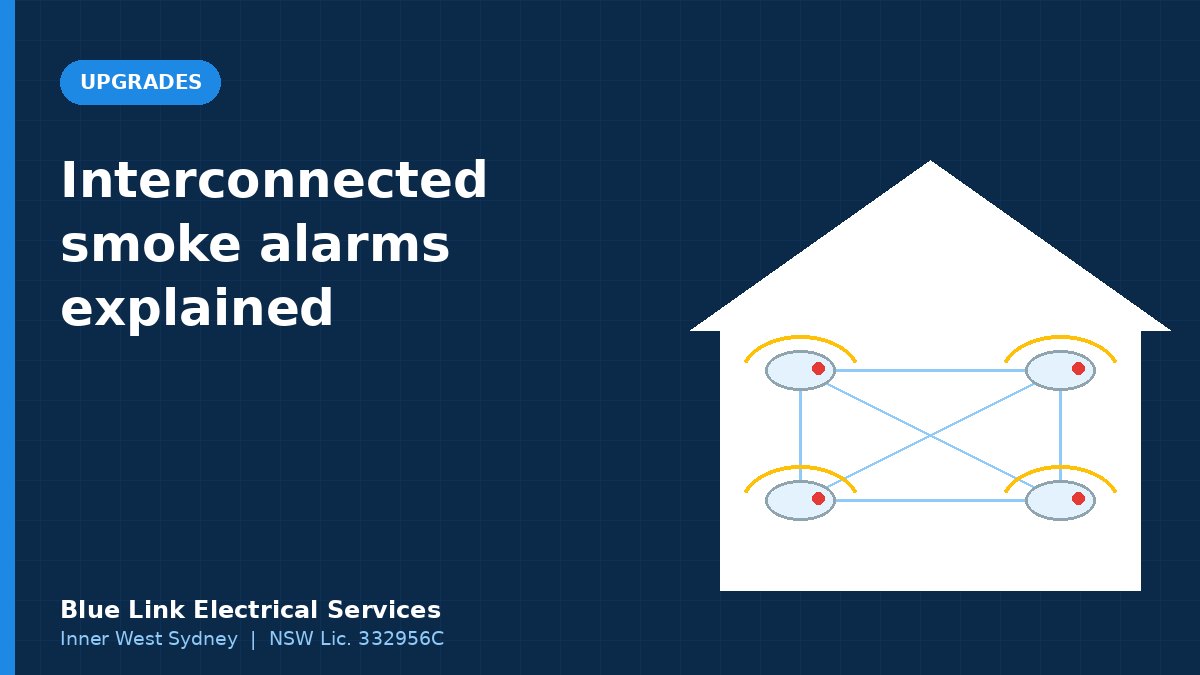
Short answer: Interconnected smoke alarms are linked so that when one detects smoke, they all sound. That means you’ll hear a fire in another part of the house, even with doors closed. They can be linked with wiring or wirelessly. In NSW, new homes with more than one alarm must have them interconnected, and Fire and Rescue NSW recommends them for every home.
A smoke alarm only helps if someone hears it. In a two-storey terrace with the bedrooms upstairs, or a long single-level home with the living area at the back, a single alarm in the hallway can easily go unheard behind a closed door. Interconnected alarms solve that.
How interconnection works
When one alarm senses smoke, it sends a signal to the others, and every alarm in the system sounds. Usually the alarm that detected the smoke has a different light pattern, so you can see where the fire started.
There are two ways to link them:
Wired interconnection
Hardwired 240V alarms are joined with an extra conductor in the cable between them. It’s reliable and doesn’t depend on radio signals, but it means running cable through the ceiling between every alarm.
Wireless interconnection
Alarms communicate by radio. Some wireless systems use 10-year lithium alarms, and some hardwired alarms have a wireless module so new alarms can join without new cables. Wireless is ideal for terraces where the ceiling can’t be accessed, or for linking a granny flat or garage.
What the rules say
| Situation | Interconnection |
|---|---|
| New homes with more than one alarm | Required under the NCC 2025 NSW housing provisions |
| Major renovations or additions | May be required; check with your certifier or builder |
| Existing homes | Not required by NSW law, but recommended by Fire and Rescue NSW |
| Rentals | Must meet the general smoke alarm law; interconnection is good practice |
Fire and Rescue NSW recommends hardwired, interconnected alarms, with alarms in every bedroom, in living areas and in hallways and stairways. The legal minimum for existing homes is lower, as covered in our NSW smoke alarm rules guide.
Where interconnection matters most
- Two-storey homes, where a fire downstairs at night needs to be heard upstairs
- Terraces and long homes, with bedrooms at one end and the kitchen at the other
- Homes with closed bedroom doors, which block sound
- Households with children, older people or heavy sleepers
- Homes with a garage, studio or granny flat that’s out of earshot
Planning a system
- List the rooms: bedrooms, hallways, living areas, stairways, and the garage if it’s attached.
- Check what you have: brand, age and whether it’s hardwired. Interconnection usually needs the same brand or compatible modules.
- Pick wired, wireless or both: use wired where ceilings are open, wireless where they’re not.
- Replace old alarms: if your current alarms are near 10 years old, replace them all together.
- Test the whole system after installation by pressing the test button on each alarm and checking every alarm sounds.
Avoiding nuisance alarms
The downside of interconnection is that a false alarm in one room sets off the whole house. To keep that to a minimum:
- use photoelectric alarms
- keep alarms out of kitchens and away from bathroom doors
- vacuum alarms every six months
- consider a heat alarm in or near the kitchen if your certifier or design allows it
If an alarm keeps sounding, see smoke alarm beeping or chirping.
Want every alarm to go off together? We install wired and wireless interconnected smoke alarms in Inner West homes. Call 0421 772 661 to talk through the best setup for your layout.
Looking after an interconnected system
Test each alarm once a month with its test button and check that every other alarm sounds too. If one stays silent, it may have lost its link, its backup battery may be flat, or it may be faulty. Check the date label on each alarm. Interconnected systems are usually installed at the same time, so when one reaches 10 years old, plan to replace them all together with compatible models. After a power cut, check that hardwired alarms have stopped chirping and are showing their normal status light.
Hardwired or battery?
Interconnection works with both. Our hardwired vs 10-year lithium guide explains the trade-offs. Landlords can find their duties in our landlord electrical safety checklist.
We install interconnected alarms in Leichhardt, Lilyfield, Annandale and Petersham.
Frequently asked questions
Are interconnected smoke alarms mandatory in NSW?
For new homes with more than one alarm, yes. For existing homes, NSW law doesn’t require interconnection, but Fire and Rescue NSW recommends it.
Can battery smoke alarms be interconnected?
Yes. Some 10-year lithium alarms interconnect wirelessly, as long as they’re from a compatible range.
Can I link new alarms to my existing hardwired ones?
Often, if they’re compatible. Some brands offer wireless modules that let new alarms join an existing hardwired system. Your electrician can check.
Why do all my smoke alarms go off at once?
That’s how interconnected alarms work. Check each alarm’s light to find the one that triggered, and make sure there’s no fire before looking for other causes.