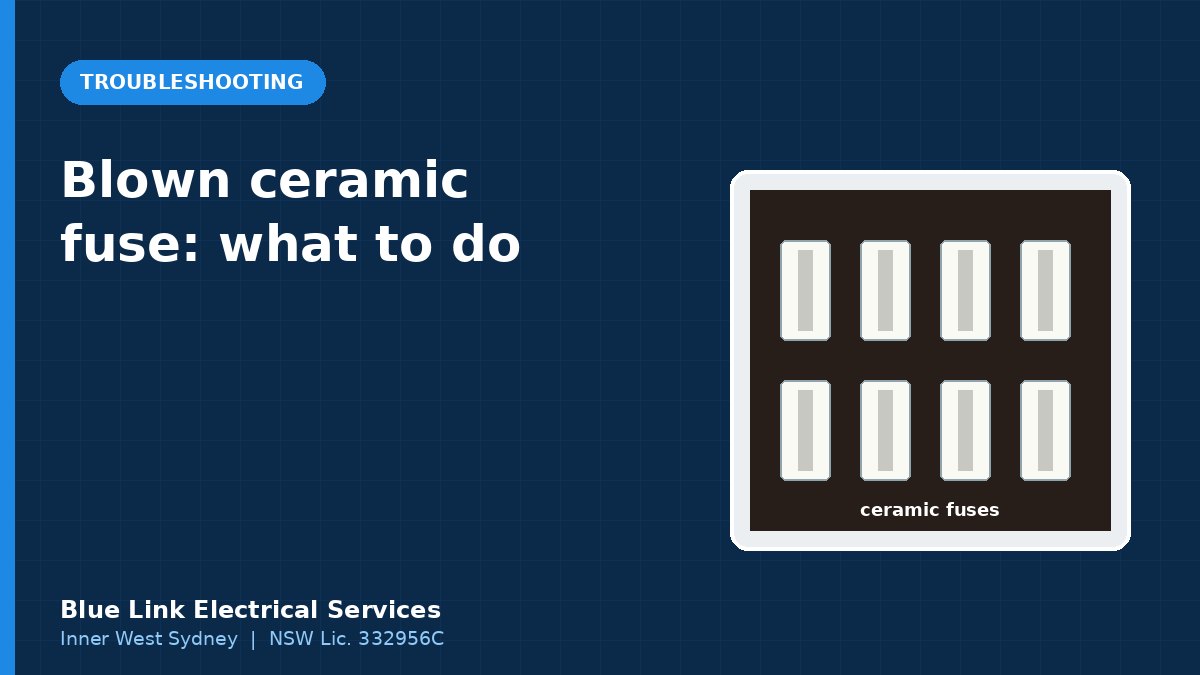
Short answer: If a ceramic fuse blows, unplug what was running on that circuit, switch off the main switch, and call a licensed electrician. Don’t rewire the fuse yourself or use thicker wire. A fuse that blows is doing its job, and the wrong wire can let the circuit overheat. Ceramic fuses also give no shock protection, so a blown fuse is a good time to talk about a switchboard upgrade.
Plenty of older homes in Marrickville, Petersham, Dulwich Hill and across the Inner West still have ceramic fuses. When one blows, half the kitchen or a row of bedrooms goes dark, and it’s tempting to grab a roll of fuse wire and fix it. This guide explains what’s happening, why DIY fuse rewiring is a bad idea, and what to do instead.
How to tell if you have ceramic fuses
Open your switchboard or meter box and look for white or cream ceramic blocks that pull out of a base, often with a coloured dot or a number such as 8, 16 or 20 on them. Inside each carrier is a thin piece of fuse wire stretched between two screws. When too much current flows, that wire melts and breaks the circuit.
Modern boards use circuit breakers (switches you flip back on) and safety switches (RCDs with a Test button). If you only see ceramic carriers and no Test button, your home probably has no shock protection at all.
What makes a ceramic fuse blow
| Likely cause | What you might notice |
|---|---|
| Overload | Fuse went while the heater, kettle and microwave were all on |
| Faulty appliance | It blows again as soon as one particular item is plugged in |
| Short circuit in wiring | It blows with nothing plugged in, sometimes with a bang or smell |
| Old, fatigued fuse wire | Wire was wrong or worn and finally gave out |
An overload is the most common cause in older homes. Circuits were designed when a house might have had a fridge, a radio and a few lights. Today one circuit can be carrying a fan heater, an air fryer and a dishwasher.
Why you shouldn’t rewire it yourself
It’s electrical work, and in NSW that needs a licence
Fuse wire replacement sits inside the switchboard, next to live parts. The NSW Government requires a licence for electrical wiring work, and doing it unlicensed can attract large fines. More importantly, the parts beside the fuse can still be live even with a fuse removed.
The wrong wire removes the protection
The fuse rating is matched to the cable it protects. If someone fits thicker wire, a nail or (we’ve all heard the stories) foil, the cable can overheat before the fuse melts. That’s how wiring inside walls and ceilings can start fires. The NSW Government notes that around 40% of house fires are caused by electrical faults.
Old boards hide other hazards
Many boards from before the late 1980s are mounted on bituminous backing boards that may contain asbestos. SafeWork NSW’s asbestos guidance says not to drill, cut or disturb these boards. Old fuse bases can also be cracked, brittle or heat damaged.
What to do, step by step
- Unplug appliances on the affected area. Leave things off.
- Check other rooms. If more than one area is out, or the whole street is dark, check Ausgrid’s outage information before assuming it’s your fuse.
- Don’t touch the board if it’s hot, smells of burning, has scorch marks or you’re unsure. Turn off the main switch only if it’s safe to reach.
- Call a licensed electrician. We’ll find out why the fuse blew, replace it with the correct rating as a temporary fix if it’s safe to do so, and tell you honestly what the board needs.
- Plan the next step. If a circuit keeps blowing, there’s an underlying cause that a new fuse won’t fix.
If you’ve lost power to part of the house and aren’t sure it’s a fuse, our guide to power out in part of the house walks through the checks.
Fuse blown in an older Inner West home? Our licensed electricians do fault finding and same-week switchboard upgrades. Call 0421 772 661 and we’ll talk you through what’s safe to do now.
Should you replace the whole board?
A blown fuse isn’t automatically a reason to replace your switchboard. But it’s often a sign of a board that was never designed for modern loads. Replacing ceramic fuses with circuit breakers and safety switches:
- adds shock protection, which ceramic fuses can’t give you
- means a trip is a flick of a switch, not a callout
- shows which circuit tripped and why
- gives you room for future loads like induction, air conditioning or an EV charger
We cover the options in replacing a ceramic fuse switchboard. If you’re weighing it up, signs you need a switchboard upgrade lists the other warning signs.
A note on the meter and main fuse
Some older meter boxes have a separate service fuse or main fuse that belongs to the supply side. If that one blows, the whole house goes out. Work on the service fuse and the supply into your home is network-side work that needs a Level 2 Accredited Service Provider or Ausgrid, not a standard electrician. Blue Link is not Level 2 accredited, so if that’s the problem we’ll tell you and point you to the right people. See what is a Level 2 electrician for more.
We work across Marrickville, Petersham, Dulwich Hill and the wider Inner West.
Frequently asked questions
Can I replace a ceramic fuse wire myself in NSW?
It’s not recommended. The fuse sits inside the switchboard near live parts, and electrical wiring work in NSW requires a licence. Using the wrong wire can also remove the protection the fuse provides.
Why does my ceramic fuse keep blowing?
Usually an overloaded circuit, a faulty appliance or a fault in the wiring. If it blows with nothing plugged in, it’s likely a wiring fault and needs an electrician.
Are ceramic fuses still legal?
Existing ceramic fuses are not automatically illegal in an existing home, but they offer no shock protection. When a switchboard is replaced or significantly altered, new work must meet current standards, which include safety switches.
Is a blown fuse an emergency?
Not usually, unless there’s burning, smoke, heat or sparking. Then turn off the main switch if it’s safe and call an electrician urgently. If someone has had a shock, call 000.