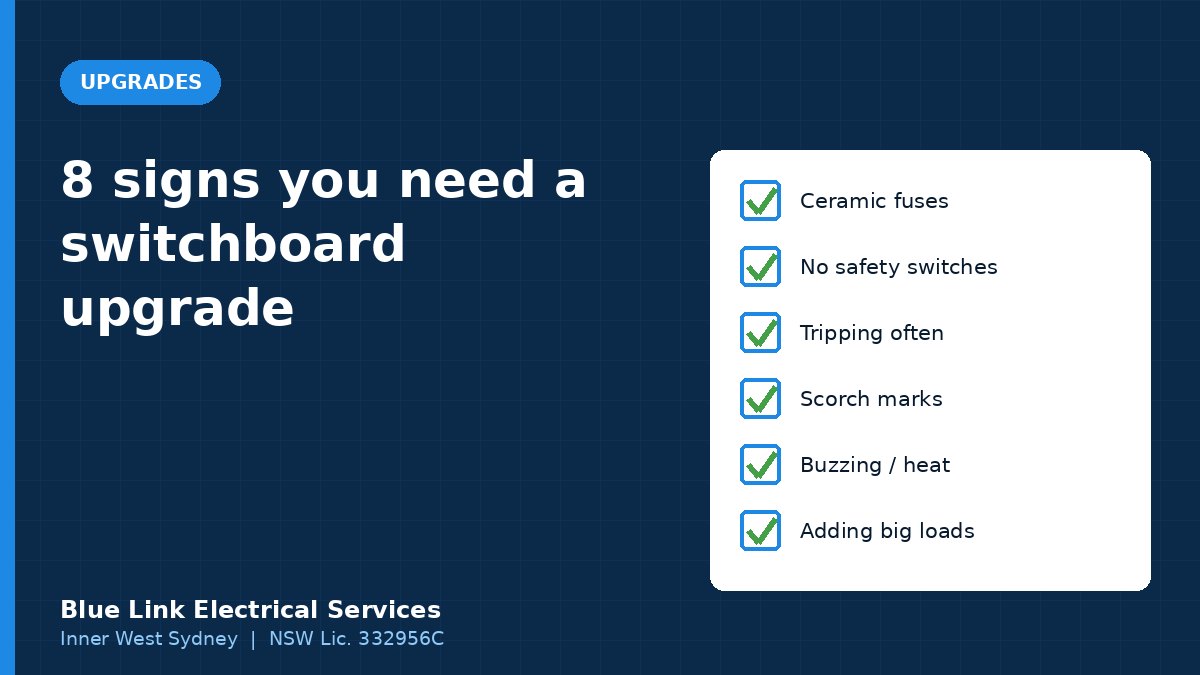
Short answer: You probably need a switchboard upgrade if you have ceramic fuses, no safety switches (or only one), a board that trips or blows fuses often, scorch marks, buzzing or heat, a possible asbestos backing board, or plans to add big loads like an EV charger, induction cooktop, ducted air or a renovation. Any one of these is worth an electrician’s look. Several together usually mean it’s time.
Your switchboard is the heart of your home’s electrical system, but most people only look at it when something goes wrong. Many Inner West homes are still running boards installed decades ago, long before air conditioning, induction cooking and EVs. Here are eight signs it might be time for an upgrade, in roughly the order of how much they matter.
1. You have ceramic fuses
Ceramic rewireable fuses (white ceramic carriers you pull out) were standard in older homes. They protect the wiring, but they offer no protection against electric shock, and rewiring a blown fuse with the wrong fuse wire can leave a circuit unprotected. If you still have them, an upgrade with modern circuit breakers and safety switches is the single biggest safety improvement you can make.
2. You don’t have safety switches, or only have one
Look for a device with a T or Test button. That’s a safety switch (RCD). No test button anywhere means no shock protection. The NSW Government says homes built in or after 2000 usually have safety switches, and for older homes it’s strongly recommended to get a licensed electrician to check.
Having just one safety switch is better than none, but it often covers only some circuits, and one fault can black out most of the house. See our guide to safety switch rules in NSW.
3. Things trip or fuses blow often
Frequent trips or blown fuses can mean:
- circuits overloaded by modern appliances
- one RCD covering too many circuits, so small leaks add up
- faulty appliances or wiring
Some causes are easy to fix, like a faulty kettle. Others mean the board’s layout no longer suits how you live. If your safety switch keeps tripping, start there.
4. Scorch marks, buzzing, heat or a burning smell
Brown or black marks, a hot board, crackling or buzzing, or a burning smell all point to loose or overheating connections. Treat this as urgent. Turn off the main switch if it’s safe to do so, and call an electrician.
5. A black, tar-like backing board
Many older boards are mounted on dark, bituminous backing boards. According to Asbestos NSW, these boards were made before 1987 and some contain asbestos. They’re safe if left undisturbed, but they shouldn’t be drilled or cut, which makes adding new circuits difficult. An upgrade can deal with this properly.
6. You’re adding big loads
Planning any of these?
- an EV charger
- an induction cooktop or new oven
- ducted or several split-system air conditioners
- a heat pump hot water system
- a kitchen or bathroom renovation, or an extension
- solar panels or a battery
Each one usually needs its own circuit and space on the board. Older boards often have no room, and adding circuits to an old board can trigger a requirement to bring protection up to current standards. An electrician should check before you buy the appliance. See our EV charger installation cost guide for one common example.
7. Power boards and double adaptors everywhere
Lots of adaptors usually means not enough circuits or outlets. The board may be fine, but often the fix involves new circuits, and that’s where the board’s capacity comes into play.
8. Old, unlabelled or DIY-modified boards
A board with handwritten or missing labels, mismatched breakers, loose covers, exposed parts, or signs of amateur work is worth checking. You should be able to switch off any circuit quickly and know what it controls.
What an upgrade involves
A typical upgrade replaces the old board with a new enclosure containing a main switch, circuit breakers, safety switches or RCBOs on every circuit, and labelling. Everything is tested, and your electrician lodges a Certificate of Compliance for Electrical Work. Under the current Wiring Rules, replacing a home’s switchboard generally means all the circuits supplied from it need 30 mA RCD protection, as the Electrical Regulatory Authorities Council explains.
If the job also needs new consumer mains, a meter move or a supply upgrade, that part is done by an Accredited Service Provider (ASP) Level 2. Blue Link isn’t Level 2 accredited, and we’ll let you know upfront if your job needs it.
For costs, see our switchboard upgrade cost guide. The NSW Government’s typical range is $1,500 to $4,000.
Ticked a few boxes? Send us a photo of your board with the cover open and we’ll tell you what we see. We upgrade switchboards across the Inner West, including Marrickville, Dulwich Hill, Croydon and Croydon Park. See our switchboard upgrades page, or call 0421 772 661.
Frequently asked questions
How old is too old for a switchboard?
Age alone isn’t the test. Condition and protection are. A board with ceramic fuses, no safety switches or signs of heat should be upgraded, whatever its age.
Are ceramic fuses illegal?
There’s no general law requiring you to remove them from an existing home, but they give no protection against electric shock. New work and switchboard replacements must meet current standards.
Can I add a circuit to my old switchboard?
Sometimes, if there’s space and the board is in good condition. An old board with no room, ceramic fuses or an asbestos backing board usually needs upgrading first.
Do I need a switchboard upgrade before selling?
It’s not required to sell, but building inspectors often flag ceramic fuses and missing safety switches, and buyers may use that in negotiations.