Short answer: NSW doesn’t force owners of existing homes to retrofit safety switches (RCDs) to old circuits, but new and altered wiring has to meet the current Wiring Rules (AS/NZS 3000:2018), which require 30 mA RCD protection for final circuits in homes. When a home’s switchboard is replaced, the circuits it supplies generally need RCD protection too. For rentals, NSW Fair Trading treats a faulty safety switch as an urgent repair, and the condition report must record whether there’s a working safety switch. The NSW Government strongly recommends having an electrician check any home built before 2000.
Safety switches are the single most important electrical safety device in a home. They cut the power in a fraction of a second when current leaks to earth, which is what happens when electricity passes through a person. But the rules about when you must have them are often misunderstood. Here’s what applies in NSW, with links to the official sources.
What a safety switch is (and isn’t)
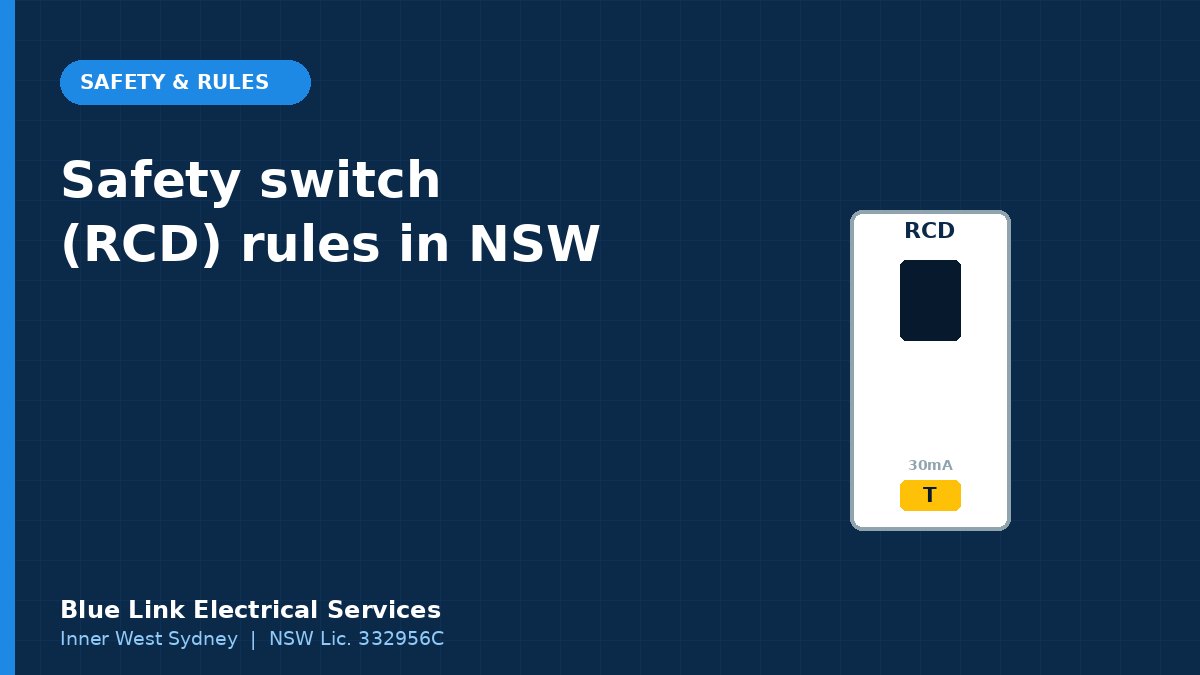
A safety switch, or residual current device (RCD), monitors the current flowing out on the active wire and back on the neutral. If some of it goes missing, leaking through a faulty appliance, damaged cable or a person, it switches off. Household RCDs are usually rated at 30 mA, and you’ll see a T or Test button on the front.
A circuit breaker is different. It protects the wiring from overloads and short circuits, but it won’t trip fast enough, or at all, to protect a person from a shock. As the NSW Government puts it, a safety switch protects people, while a circuit breaker protects circuitry and wiring.
Do existing homes have to have safety switches?
There’s no general NSW law requiring owner-occupiers to retrofit RCDs to every existing circuit. However:
- New circuits and new work must comply with AS/NZS 3000:2018, which requires 30 mA RCD protection on final subcircuits in homes.
- Switchboard replacements generally bring all the final subcircuits supplied from the new board under that requirement. The Electrical Regulatory Authorities Council explains the rules for alterations in its advisory note.
- Like-for-like repairs (for example, replacing a broken power point in the same spot) generally don’t trigger the requirement on their own.
The NSW Government says homes built in or after 2000 usually have safety switches, and for homes built before 2000 it’s strongly recommended that you ask a licensed electrician to check. That covers a large share of Inner West housing, from terraces in Newtown and Enmore to Federation homes in Haberfield and Croydon.
Is one safety switch enough?
Often not. The NSW Government notes that a safety switch only protects the circuits it’s connected to, and older homes may have a single RCD covering several circuits, or only covering the power points and not the lights. One fault can then black out a large part of the house.
Modern practice is to spread circuits across several RCDs, or to use RCBOs (a combined safety switch and circuit breaker for each circuit) so one fault only affects one circuit. See our guide to RCD vs RCBO.
Rental properties
NSW rental rules focus on working order and urgent repairs. According to NSW Fair Trading:
- Any electrical fault in a rental property, before or during a tenancy, is an urgent repair.
- The condition report includes whether there is a safety switch and whether it works. Both parties must indicate this.
- Testing the safety switch is the only way to confirm it works at the start of a tenancy.
- If a safety switch is faulty or keeps detecting a fault, it’s an urgent repair.
Landlords also have a general duty to provide premises that are fit to live in and to meet health and safety laws. Many landlords choose to have safety switches fitted to all circuits, because it reduces risk and urgent call-outs.
How often should you test?
Testing is simple. Warn everyone in the house, press the T button on each safety switch, check the power goes off, then switch it back on. NSW Government guidance recommends testing regularly; its home electrical safety page says twice a year, and its consumer rights page suggests every three months. Pick a regular reminder, such as when the clocks change.
If a safety switch doesn’t trip when tested, or trips but won’t reset, call a licensed electrician.
What it costs
The NSW Government says a simple safety switch installation can cost a few hundred dollars, depending on what your home needs. The hipages cost guide lists safety switch installation at $90 to $250 (national averages). If your board has ceramic fuses or no room, the right fix may be a full switchboard upgrade. These are typical market figures, not Blue Link prices.
Why it’s worth doing even if it’s not required
The NSW Government says around 40% of house fires in NSW each year are caused by electrical faults and electrical appliances. Safety switches are the main defence against fatal shocks, and they can help catch faults before they turn into fires. Fitting them is one of the best-value safety upgrades you can make.
Not sure what your switchboard has? Send us a photo, or book a check. We fit safety switches across the Inner West, including Marrickville, Leichhardt, Dulwich Hill and Petersham. See our switchboard upgrades page, or call 0421 772 661.
Frequently asked questions
Is it illegal to not have a safety switch in NSW?
For an existing owner-occupied home, there’s no general law requiring you to retrofit one. New work, new circuits and switchboard replacements must meet the current Wiring Rules, which require RCD protection.
Do rental properties in NSW need safety switches?
NSW rental law requires premises to be fit to live in and safe, records the safety switch on the condition report, and treats a faulty safety switch as an urgent repair. Check NSW Fair Trading’s guidance for your situation.
How do I know if I have a safety switch?
Look in your switchboard for a device with a T or Test button, often marked 30mA. If you only see ceramic fuses or plain circuit breakers, you may not have one.
Does a safety switch protect against electrical fires?
It mainly protects people from electric shock by detecting current leaking to earth. It can also cut power on some earth-leakage faults that could otherwise cause heat damage, but it isn’t a fire alarm. You still need working smoke alarms.