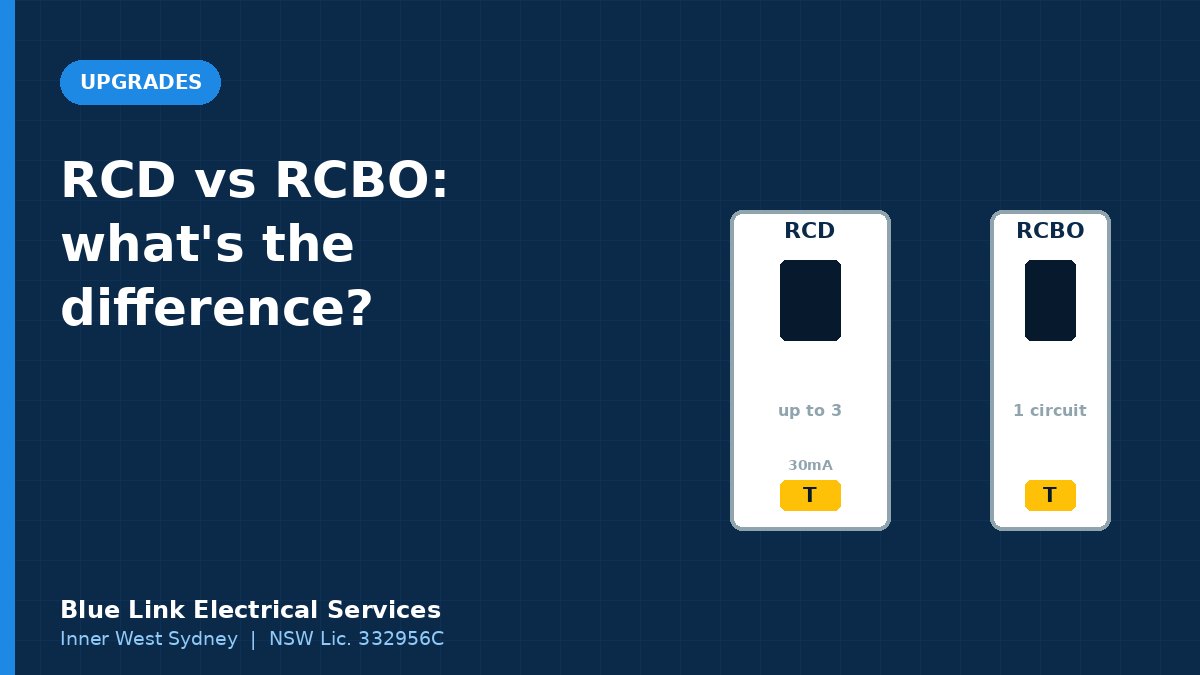
Short answer: An RCD (safety switch) protects people from electric shock by cutting power when current leaks to earth, and one RCD usually protects several circuits. An RCBO combines an RCD and a circuit breaker in one device, protecting a single circuit against earth leakage, overloads and short circuits. With RCBOs, one fault only takes out one circuit, not half the house. RCBOs cost more per circuit but give better fault isolation, and they’re common in switchboard upgrades.
If you’ve had a switchboard quote recently, you may have seen both “RCD” and “RCBO” and wondered whether the difference matters. It does, mainly for convenience and fault-finding. Both protect you from electric shock. This guide explains the difference in plain English, so you can make the right call for your home.
The three devices in your switchboard
Circuit breaker (MCB)
A circuit breaker protects the wiring from overloads (too much current for too long) and short circuits. It’s what trips when you run the heater, kettle and toaster on one circuit. It doesn’t protect people from electric shock.
RCD (residual current device, or safety switch)
An RCD protects people. It compares the current going out on the active wire with the current returning on the neutral. If they differ, meaning some current is leaking, perhaps through a person to earth, it switches off in a fraction of a second. Household RCDs are typically rated at 30 mA. An RCD doesn’t protect against overloads, so it’s paired with circuit breakers.
In many switchboards, one RCD sits upstream of several circuit breakers and protects all of those circuits.
RCBO (residual current breaker with overcurrent protection)
An RCBO combines both jobs in one device. It protects a single circuit against earth leakage (like an RCD) and overloads and short circuits (like a circuit breaker). Each circuit gets its own RCBO.
Side by side
| RCD + circuit breakers | RCBO per circuit | |
|---|---|---|
| Shock protection | Yes | Yes |
| Overload and short-circuit protection | Via separate circuit breakers | Built in |
| Circuits affected by one earth fault | All circuits on that RCD | Just the one circuit |
| Nuisance tripping from many small leakages | More likely, because leakages add up | Less likely |
| Finding a fault | Harder: you know which group, not which circuit | Easier: the tripped device tells you the circuit |
| Switchboard space | Can be compact for a few circuits | One device per circuit, usually compact |
| Cost | Usually lower upfront | Usually higher upfront |
Why one fault blacking out half the house matters
Picture an older board with one RCD protecting the power points, the lights and the kitchen. A faulty kettle trips the RCD, and suddenly the whole house is dark, including the lights you need to find the switchboard. With RCBOs, the kettle trips only the kitchen power circuit. The lights stay on, the fridge keeps running, and it’s obvious which circuit has the problem.
That’s also why the Wiring Rules limit how many circuits share one RCD in a home. The NSW Government also points out that one safety switch may not be enough, because it only protects the circuits it’s connected to, and older homes may have a single safety switch covering several circuits.
What the rules require
Under AS/NZS 3000:2018, final subcircuits in homes need 30 mA residual current protection. Either RCDs or RCBOs can provide it. When a home’s switchboard is replaced, the circuits supplied from it generally need that protection, as the Electrical Regulatory Authorities Council explains. So the choice between RCDs and RCBOs is mostly about convenience, fault isolation and budget, not about meeting the minimum.
Some equipment, like EV chargers, solar inverters and batteries, has specific requirements for the type of residual current protection. Your electrician will follow the equipment maker’s instructions.
Which should you choose?
RCBOs on every circuit make the most sense when:
- you’re upgrading the whole switchboard anyway
- you want the least disruption when something faults
- you have critical circuits like fridges, freezers, medical equipment or a home office
- your old setup suffers nuisance tripping
A few RCDs with circuit breakers can make sense when:
- you’re adding protection to a board that’s otherwise in good shape
- budget is tight and the number of circuits is small
Many electricians recommend RCBOs throughout for a new board, because the extra cost is modest compared with the whole upgrade, and the day-to-day benefit is real.
Testing either type
Both RCDs and RCBOs have a T or Test button. Press it regularly to check the device trips, then switch it back on. NSW Government guidance recommends testing every few months; see our guide to safety switch rules in NSW.
If a device won’t reset, see why your safety switch keeps tripping.
Cost
RCBOs cost more per circuit than sharing one RCD across several circuits, so a board with RCBOs throughout usually costs more. See our switchboard upgrade cost guide. The NSW Government’s typical range for a switchboard upgrade is $1,500 to $4,000.
Weighing up RCDs or RCBOs? We’ll explain the options for your board in plain English. We upgrade switchboards and fit safety switches across the Inner West, including Marrickville, Ashfield, Croydon and Leichhardt. See our switchboard upgrades page, or call 0421 772 661.
Frequently asked questions
Is an RCBO better than an RCD?
Both protect against electric shock. An RCBO protects one circuit and includes overload protection, so a fault only affects that circuit. That makes RCBOs more convenient, but they cost more per circuit.
Can I replace my RCD with RCBOs?
Usually, yes, as part of a switchboard upgrade or rearrangement, if there’s space and the board is suitable. An electrician will check your board.
Why does my RCD trip but no circuit breaker does?
An RCD trips on earth leakage, often from a faulty appliance or moisture. Circuit breakers trip on overload or short circuit. The two detect different faults.
Do RCBOs have a test button?
Yes. Like RCDs, RCBOs have a T or Test button. Press it regularly to make sure the device trips.