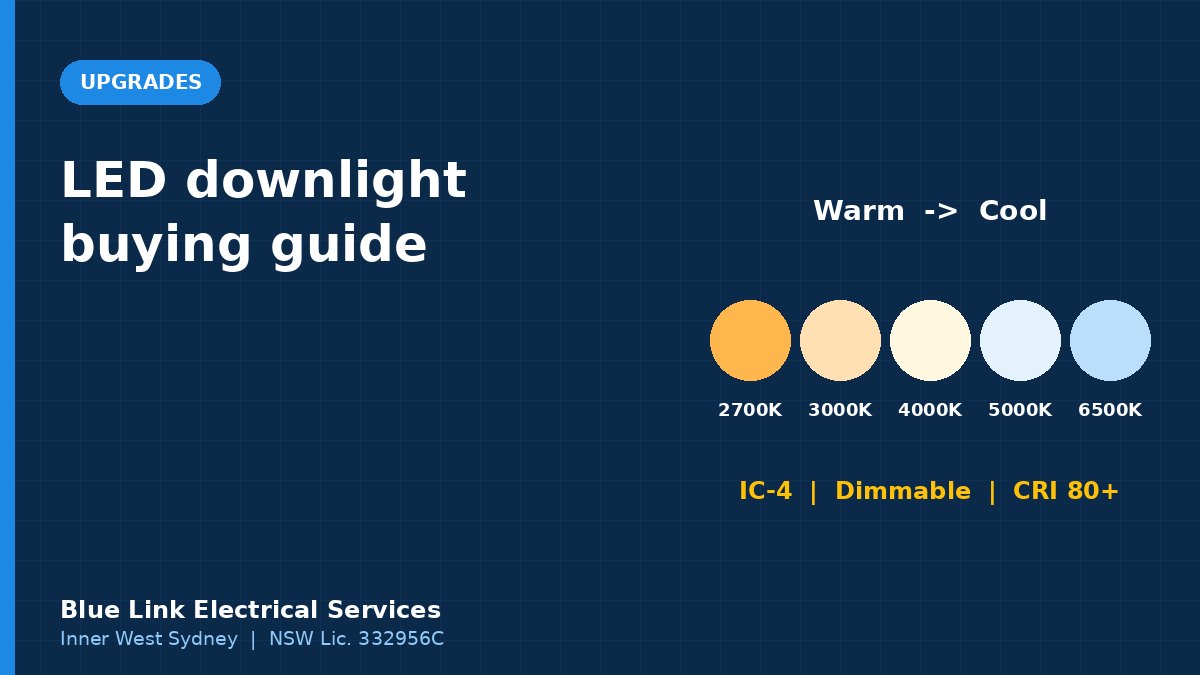
Short answer: When choosing LED downlights, focus on six things: colour temperature (warm 2700–3000K for living areas, neutral 4000K for kitchens and work areas), brightness in lumens (not watts), beam angle, colour rendering (CRI 80+, ideally 90+), an IC-4 rating if your ceiling is insulated, and dimmer compatibility if you want to dim them. Tri-colour downlights that let you choose the colour on install are a useful safety net.
Walk into any lighting shop or browse online and you’ll find hundreds of downlights that look almost identical. The differences are in the specs, and getting them wrong can leave you with a kitchen that feels like a hospital or a living room that buzzes every time you dim the lights. This guide explains each spec in plain English.
1. Colour temperature: warm, neutral or cool
Colour temperature is measured in kelvin (K). Lower numbers are warmer and more yellow. Higher numbers are cooler and bluer.
| Colour temperature | Look and feel | Good for |
|---|---|---|
| 2700K–3000K (warm white) | Cosy, similar to old incandescent globes | Living rooms, bedrooms, dining areas |
| 4000K (neutral or cool white) | Crisp, clean, more “daylight” | Kitchens, laundries, bathrooms, home offices |
| 5000K–6500K (daylight) | Very white to bluish | Garages and workshops. Usually too stark for living spaces |
Tip: pick one colour for each open-plan space. Mixing warm and cool lights in the same room looks patchy.
Tri-colour (CCT selectable) downlights
Many downlights now have a small switch on the driver to set warm, neutral or cool on installation. They’re a great choice if you’re not sure, because the electrician can change the colour without replacing the fitting. Some can also be switched by flicking the wall switch, but that can be confusing for guests.
2. Brightness: lumens, not watts
With LEDs, watts tell you how much power the light uses, not how bright it is. Look at lumens (lm). Two 10-watt downlights can have quite different lumen outputs. Compare lumens per fitting when you shop.
How much light you need depends on the room size, ceiling height, wall colour and what the room is for. Kitchens and work areas need more light than bedrooms. If you’re unsure, a dimmer gives you flexibility.
3. Beam angle
Beam angle is how widely the light spreads.
- Narrow beams (around 36°–60°): more focused. Good for highlighting artwork or benches, but can create pools of light and shadow.
- Wide beams (around 90°–120°): a softer, more even spread. Good for general lighting in most rooms.
For general room lighting, wider beams usually mean fewer lights and a more even result.
4. Colour rendering (CRI)
CRI tells you how accurately a light shows colours, on a scale up to 100. Cheaper LEDs can make food, skin and timber look dull or slightly grey.
- CRI 80+: acceptable for most rooms
- CRI 90+: noticeably better, especially in kitchens, bathrooms and anywhere you put on makeup or choose clothes
5. IC-4 rating (insulation contact)
If your ceiling has insulation, or you plan to add it, choose IC-4 rated downlights. IC-4 downlights are designed and tested under AS/NZS 60598.2.2 to be covered by building insulation. Older non-IC fittings needed clearance gaps around them, which leaves holes in your insulation and lets heat escape through the ceiling. Your electrician can confirm the rating suits your ceiling.
6. Dimmer compatibility
This is where many LED installs go wrong. Not every LED works with every dimmer.
- Make sure the downlight is labelled dimmable.
- Check the maker’s list of compatible dimmers.
- Don’t reuse an old halogen dimmer without checking.
- Some dimmers need a minimum load, which a small number of LEDs may not reach.
A mismatch causes flicker, buzzing, limited dimming range or lights that glow faintly when off. See why are my lights flickering for more.
Other things to check
- Cut-out size: if you’re replacing old downlights, match the new fitting to the existing hole where possible to avoid extra cutting and patching.
- IP rating: bathrooms, eaves and outdoor areas need a suitable IP rating for moisture.
- Driver quality: the driver powers the LED, and cheap drivers are often the first thing to fail. A good warranty is a good sign.
- Lead and plug: many downlights come with a lead and plug for connection to a ceiling outlet, which makes future replacement easier.
- Finish and trim: white, black or brushed finishes, round or square trims, fixed or tilting. Tilting (gimbal) fittings are useful on sloped ceilings or for aiming at artwork.
- Warranty: look for a reasonable warranty from a supplier with a local presence.
Downlights and older Inner West ceilings
Downlights aren’t always the right answer. Pressed-metal ceilings, ornate plaster and lath-and-plaster ceilings in older homes can be damaged by cutting, and some have very little space above for the fitting. In those rooms, pendants, surface-mounted fittings or wall lights often look better and protect the ceiling. If you live in an older home, see our guide to old wiring in Inner West terraces and Federation homes.
Installation
Installing downlights is licensed electrical work in NSW. See our downlight installation cost guide for what affects the price.
Want help choosing? We’ll recommend fittings that suit your rooms and ceilings, and install them properly. We work across the Inner West, including Dulwich Hill, Leichhardt, Petersham and Croydon. See our indoor lighting page, or call 0421 772 661.
Frequently asked questions
What colour downlights are best for a living room?
Most people prefer warm white (2700K to 3000K) for living rooms and bedrooms. It’s softer and more relaxing than cool white.
What does IC-4 mean on a downlight?
IC-4 means the downlight is designed and tested to be covered by ceiling insulation. It’s the rating to look for if your ceiling is insulated.
Why do my new LED downlights buzz?
Buzzing usually comes from an incompatible dimmer or a low-quality driver. An LED-compatible dimmer or better-quality fittings usually fix it.
Are tri-colour downlights worth it?
They’re a good choice if you’re unsure which colour you’ll like, because the colour can be changed without replacing the fitting.