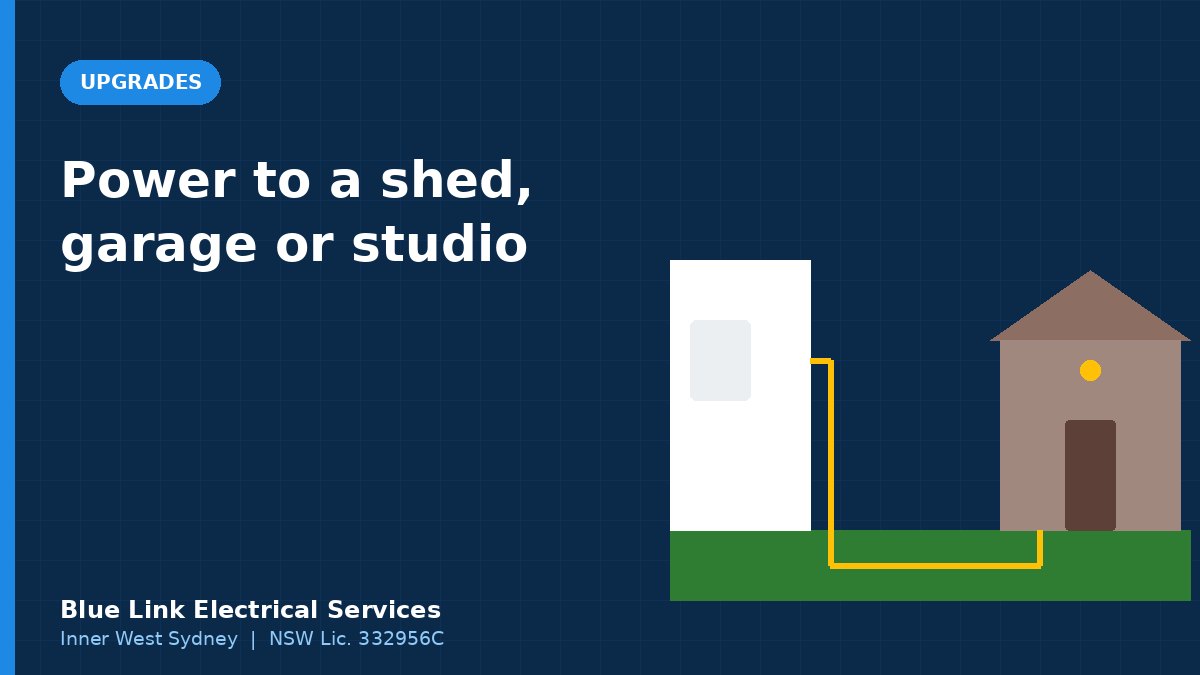
Short answer: The safe way to power a shed, garage or backyard studio is a dedicated circuit from your switchboard, run as a properly protected cable (usually underground) to weatherproof outlets and lights. Larger studios may need a sub-board. A permanent extension lead from the house isn’t a safe or compliant solution. All of this is electrical work for a licensed electrician.
Sheds and backyard studios are popular in the Inner West: a workshop behind a Marrickville cottage, a home office at the end of a Leichhardt garden, a garage off a rear lane in Annandale. Getting reliable power out there safely takes a bit of planning. Here’s how it works.
Why not just an extension lead?
An extension lead running across the yard is fine for a one-off job with the mower. As a permanent supply it’s a problem:
- leads aren’t designed for permanent outdoor use or burial
- they’re easily damaged by mowers, doors and weather
- they’re often overloaded with heaters or power tools
- joints in leads get wet
If an extension lead is your shed’s only power, it’s time for a proper circuit.
What a proper installation looks like
| Part | What’s involved |
|---|---|
| Circuit at the switchboard | New circuit breaker and safety switch protection |
| Cable route | Usually underground, in conduit and at the depth the wiring rules require, or fixed along structures |
| In the shed | Weatherproof or suitably rated power points, light fittings and switches |
| Sub-board (if needed) | A small switchboard in the shed for several circuits |
| Earthing | Correct earthing for the outbuilding |
| Testing and certificate | Tested and a CCEW lodged |
How much power do you need?
Make a list of what you’ll run:
- Light use: lights, a few power points, phone chargers, small tools
- Workshop: saws, compressors, welders, dust extraction
- Studio or office: computers, heating and cooling, a kettle, maybe a small fridge
- Garage: door motor, freezer, and maybe an EV charger
Big loads like air conditioning, heaters and workshop machinery may need a larger cable and a sub-board. Your electrician will check your main switchboard has the space and capacity.
Cable routes in small backyards
Inner West yards bring their own challenges:
- Paving and concrete may need cutting or boring under
- Narrow side passages limit trenching
- Rear lane garages may be far from the switchboard at the front of the house
- Existing services like water, sewer and stormwater must be avoided
Sometimes it’s easier to run cable along a fence or wall in suitable conduit, or through the house and out the back. Your electrician will suggest the most practical route. If you’re doing landscaping or paving anyway, lay conduit first.
Lighting outside the shed
While cabling to the shed, it’s a good time to add path lighting and a sensor light at the door. See our outdoor and garden lighting guide.
Garages: doors, freezers and EVs
Attached and rear-lane garages often end up with a tangle of power boards for the door motor, a chest freezer and tools. A dedicated power point for the door motor and another for the freezer, both protected by a safety switch, is safer and more reliable. If you might buy an electric car, plan for an EV charger circuit now. Our guide to choosing a home EV charger explains the options.
Data to the studio
Working from a backyard studio? Wi-Fi from the house often won’t reach. Options include a data cable run alongside the power cable (in its own conduit, done by a registered cabler) or an outdoor wireless link. See Wi-Fi dead spots.
Studio or granny flat?
If your studio has a kitchen, bathroom and someone living in it, it may be a secondary dwelling (granny flat), which has different approvals and may need a bigger supply. See granny flat electrical.
Want safe, reliable power in your shed or studio? Call 0421 772 661 to talk through your loads and cable route, or see our lighting and power service.
Cost factors
We don’t publish set prices. What changes the cost:
- distance from the switchboard
- trenching, paving and boring
- the number of power points and lights
- whether a sub-board is needed
- whether the main switchboard needs upgrading
- data cabling or outdoor lighting added at the same time
We work in Annandale, Lilyfield, Marrickville and Leichhardt.
Frequently asked questions
Can I run power to my shed with an extension cord?
Only temporarily. For permanent power, a licensed electrician should install a proper circuit with protected cabling and weatherproof outlets.
Does a shed need a sub-board?
Not always. Light use can often be supplied by a single circuit. Workshops and studios with heavy loads often need a sub-board.
How deep does a cable to a shed need to be buried?
The wiring rules set depth and protection requirements depending on the cable and installation method. Your electrician will install it to suit.
Can I dig the trench myself to save money?
Sometimes, if your electrician agrees and specifies the route and depth. The electrician must still lay, protect, connect and test the cable.