
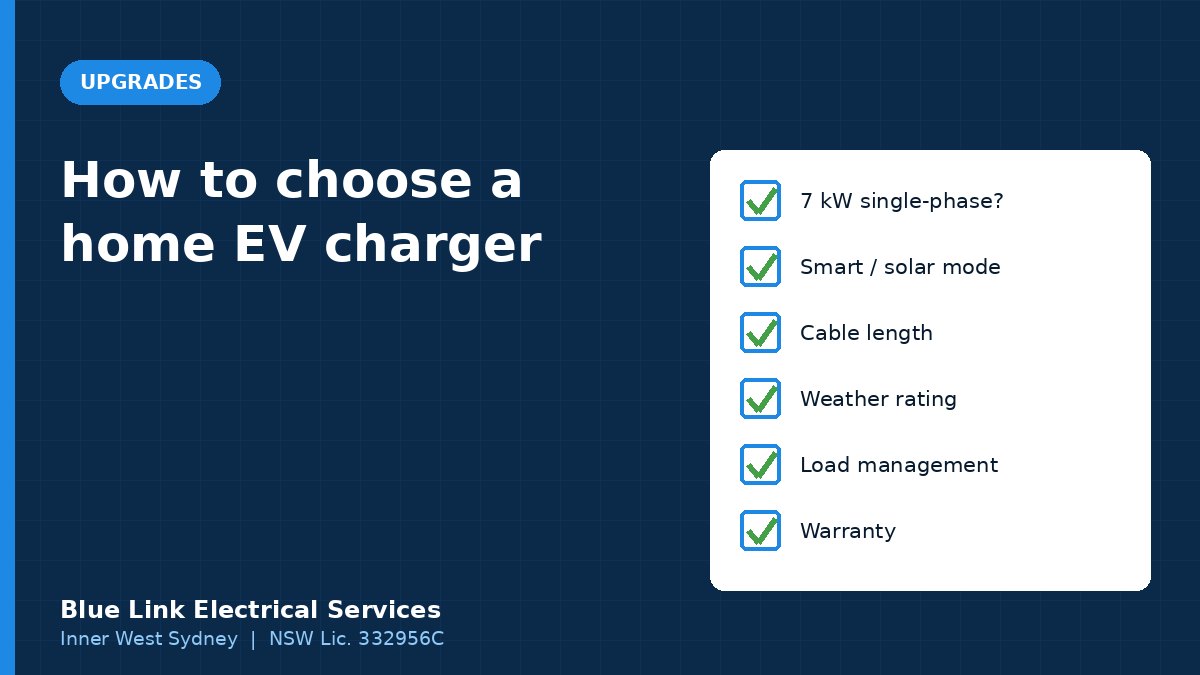
Short answer: For most Sydney homes, a single-phase wall charger of about 7 kW is the sweet spot. It can add a full day’s driving overnight for most people. Before you buy, check: what your car can accept, whether you have single or three-phase power, smart scheduling features, load management, cable length and type (tethered or socket), weather rating, and warranty. Then get an electrician to check your switchboard and the cable route before you order. We are based in the Inner West; our EV charger installation in the Inner West page explains how we approach older homes there.
Choosing a home EV charger is easier than it looks once you know which features actually matter. This guide walks through the decisions in the order you should make them, so you don’t pay for features you can’t use, or buy a charger your home can’t support.
Step 1: Know your three charging options
| Option | Typical power | What it means in practice |
|---|---|---|
| Portable charger in a standard power point | About 2.3 kW (10 A) | Slow. Fine for short daily trips. Have the circuit checked if you use it daily. |
| Single-phase wall charger | Up to about 7 kW (32 A) | The most common home setup. Suits most daily driving. |
| Three-phase wall charger | Up to about 11 kW or 22 kW | Faster, but needs three-phase power, and your car must support it. |
Speeds are approximate. Real charging speed depends on your car, your supply and the charger settings.
Step 2: Check what your car can accept
Your car has an onboard charger that limits how fast it can take AC power from a wall charger. If your car accepts 7.4 kW, a 22 kW charger won’t charge it any faster. Check the car’s specifications or ask your dealer. Most EVs sold in Australia use a Type 2 connector for AC charging.
Step 3: Single-phase or three-phase?
Look at your switchboard and meter, or ask your electrician. Most Inner West houses are single-phase, and a single-phase 7 kW charger suits most people.
If you’re thinking of upgrading to three-phase just for faster charging, think carefully. Changing your supply is contestable network work on the connection, with Ausgrid involved, and it’s level 1 and 2 work arranged through accredited partners. It adds real cost, so we’ll tell you if your plans need it.
Step 4: Features worth paying for
Smart scheduling
Lets you charge during cheaper off-peak periods, if your electricity plan has them. Most smart chargers do this through an app.
Smart scheduling
If you’re on a time-of-use plan, a charger that schedules charging for off-peak rates can make a big difference to running costs. Load management usually needs an energy meter or CT clamp.
Load management
This is the most underrated feature. A load-managed charger watches your home’s total use and slows charging when the oven, air conditioner and hot water are all running. It can avoid tripping your main switch, and sometimes avoids the need for a supply upgrade.
Built-in DC fault protection
EV charging circuits need the right type of residual current protection. Some chargers have built-in DC leakage detection, which can make the switchboard side simpler. Your electrician will follow the charger maker’s installation instructions and the Wiring Rules.
Step 5: Practical details
- Tethered or socket? A tethered charger has the cable attached, which is convenient. A socket (untethered) charger looks neater and lets you use your own cable.
- Cable length: measure from the planned charger spot to your car’s charge port, allowing for how you park. 5 metres is a common tethered length, but check.
- Weather rating: outdoor chargers need a suitable IP rating. Carports and open driveways get rain and sun.
- Mounting spot: close to the switchboard is cheaper to install. Out of the way of car doors and foot traffic is safer.
- Wi-Fi or mobile signal: smart features need a connection at the charger location.
- RCM tick: the NSW Government says to only use chargers that carry the Regulatory Compliance Mark (RCM) tick.
- Warranty and support: check the warranty length and whether there’s local support.
- Security: a lockable or PIN-protected charger is worth considering if it’s accessible from the street, which is common with rear-lane parking.
Step 6: Apartments and strata
If you live in an apartment, talk to your strata manager first. The charger may need to connect to your own unit’s supply, a common-property circuit or a shared building system, and you’ll usually need owners corporation approval. The building’s electrical capacity matters too.
NSW strata law treats EV charging as sustainability infrastructure. A sustainability infrastructure resolution passes as long as no more than 50% of the value of the votes cast are against it, provided certain conditions are met. You’ll usually also need a by-law covering things like metering, maintenance and who pays. Tenants need the landlord’s approval first. Our EV charging in NSW strata guide has the detail.
Step 7: Get the install checked before you buy
Send your electrician a photo of your switchboard (cover open), where you park, and the charger you’re considering. They can tell you whether your board has space, whether it needs an upgrade, and roughly how long the cable run is. See our EV charger installation cost guide for what affects the price, and our switchboard signs guide if your board is old.
The NSW Government’s Home Energy Saver loans offer eligible households zero-interest loans for upgrades including EV chargers. Check eligibility on the official page.
The loan is for NSW homeowners and landlords who are Australian citizens or permanent residents and meet the household income limit. An EV Level 2 charger and a switchboard upgrade are both on the Home Energy Saver list of eligible upgrades. You apply through one of the program’s finance providers, and the work is done by one of their approved suppliers.
What a Level 2 install involves
- Switchboard and supply check: spare capacity, room for a new circuit with safety switch protection, and how the charger will share power with your air con, oven and hot water.
- A dedicated circuit from the switchboard to the charger, with the right cable size and protection for the run length.
- Mounting where the cable reaches the car comfortably (see Step 5).
- Testing and set-up, including the app or load management, and the Certificate of Compliance for Electrical Work, which the electrician must lodge no later than seven days after testing.
Choosing a charger? We’ll check your board and recommend a charger that suits your car and your home. We install across the Inner West, including Marrickville, Petersham, Croydon Park and Ashfield. See our EV charger installation page, or call 0421 772 661.
We also help homeowners and businesses in Kingsford, Concord, Rosebery, Randwick and Paddington with the same issue — see those local electrician pages for suburb-specific notes.
Frequently asked questions
What size EV charger do I need at home?
For most people, a single-phase charger of about 7 kW is plenty. It can typically recharge a day’s driving overnight. Check your car’s maximum AC charging rate before buying anything bigger.
Is a smart EV charger worth it?
If you have a time-of-use electricity plan, usually yes. Smart scheduling for off-peak rates can noticeably reduce running costs, and load management can prevent tripping.
Can I install an EV charger myself?
No. A wall charger needs a dedicated circuit and must be installed by a licensed electrician, who tests it and lodges a Certificate of Compliance for Electrical Work.
Will any charger work with my car?
Most EVs in Australia use a Type 2 connector for AC charging, so most wall chargers are compatible. Check your car’s specifications to be sure.
Can I use the Home Energy Saver loan for an EV charger?
If you’re eligible, yes. An EV Level 2 charger is on the list of eligible upgrades for the NSW Government’s zero-interest Home Energy Saver loan, which is for NSW homeowners and landlords. Your chosen finance provider checks eligibility. See energy.nsw.gov.au for the current rules.
Will I need a switchboard upgrade for an EV charger?
Not always. It depends on your board’s capacity, space and safety switch protection. We check this before quoting.
Can I install an EV charger in my apartment car space?
Yes, with owners corporation approval. NSW strata law treats EV charging as sustainability infrastructure, but you still need a resolution and usually a by-law. Tenants need the landlord’s approval first.